
Health
We recommend consulting your GP or a travel clinic now so you can make an informed decision about your health and travel vaccination requirements. Our primary goal is that you have a safe, enjoyable and memorable Kilimanjaro climb.
Ask if you have any pre-existing medical conditions that may cause problems on a high altitude climb and check if any of your existing medications affect altitude acclimatisation.
Check whether Diamox can be taken with any existing prescription medicines if you are intending on taking this or administering it in the event of AMS.
BEFORE DEPARTURE: Prepare a list of your medications, including the name, dosage, prescribing doctor and their phone number. A copy of your prescriptions is vital in case of any health problems. If you have health problems, ask your doctor to prepare your medical history for a foreign doctor. It should include your name, address, emergency contact, blood type, medical history, current medications and dosages, drug allergies, reasons for prior hospitalisations and list of immunisations and dates. Pack sufficient medication for the duration of your tour. Your medication should be kept close at hand in your purse or carry-on bag. Due to strict drug laws, medication will need to be in an original container that shows the prescription label. It is your responsibility to be informed of what medication is/isn’t permitted and to carry a Dr’s Certificate for any prescription essentials.
There are no compulsory vaccinations required for entry to Tanzania unless you are arriving from a country listed by the World Health Organisation (WHO) as having Yellow Fever, in which case a Certificate of Inoculation against Yellow Fever is required from travellers older than one year. It is also required for travellers having transited for more than 12 hours through an airport of a country with risk of yellow fever transmission.
Some countries, including Australia require arriving visitors from Kenya to have a Yellow Fever vaccination certificate. So if you are returning to or travelling to one of these countries after a stay in Kenya then you need to have a Yellow Fever certificate.
Other health precautions recommended by the WHO and CDC include:
Typhoid, Hepatitis A and B, Meningitis, Polio, Influenza & Measles, mumps and rubella (MMR)
As a precaution, all water should be regarded as potentially contaminated. We recommend using bottled water for drinking, brushing teeth, and washing fruit. Avoid ice. Water purification tablets are something to consider if you want to be extra cautious.
Use Alcohol-based hand sanitiser or antibacterial hand wipes.
Prepare a travel health kit with self-medicating items for common travel-related illnesses.
Vaccinations
It is your responsibility to ensure that you are immunised.
We recommend consulting your GP or a travel clinic now so you can make an informed decision about your health and travel vaccination requirements.
There are no compulsory vaccinations required for entry to Tanzania unless you are arriving from a country listed by the World Health Organisation (WHO) as having Yellow Fever, in which case a Certificate of Inoculation against Yellow Fever is required from travellers older than one year. It is also required for travellers having transited for more than 12 hours through an airport of a country with risk of yellow fever transmission.
Some countries, including Australia require arriving visitors from Kenya to have a Yellow Fever vaccination certificate. So if you are returning to or travelling to one of these countries after a stay in Kenya then you need to have a Yellow Fever certificate.
Other health precautions recommended by the WHO and CDC include:
Typhoid, Hepatitis A and B, Meningitis, Polio, Influenza & Measles, mumps and rubella (MMR)
Malaria
The risk of contracting Malaria is prevalent throughout Tanzania and the most important preventive strategy is to avoid getting bitten.
Malaria transmission is limited by temperature, humidity and altitude and can vary significantly from region to region, you will not be at risk of Malaria above 1800m. Because mosquitoes like hot, damp conditions, coastal areas are usually at higher risk, as are low areas of rainforest and jungle. Chloroquine-resistant Plasmodium falciparum is endemic throughout Tanzania and we recommend anyone travelling with us to seek medical advice before travelling. The rainy season increases your risk of infection as this is when mosquitoes are most prevalent.
Whether or not you opt to take anti-malarial medication, we recommend the following (particularly at dawn and dusk when significant risk exists):
Use insect repellant - DEET (Insect repellents that contain DEET offer the best protection against mosquito bites.)
wear light coloured, loose fitting clothing, mosquitoes easily get attracted to dark colours. For extra protective measures, cover yourself up in full sleeves shirts, t-shirts & trousers as mosquitoes find it hard to bite through fabric.
wear shoes and socks as some mosquitoes tend to focus on the ankles and feet rather than other exposed areas of the body
sleep with a mosquito net
Mosquitoes easily get attracted to the smell of sweat so be sure to shower regularly
Mosquitoes are also attracted to certain fragrances in perfumes, colognes, lotions, soaps, and shampoos so avoid scented soaps, shampoos, deodorants, perfumes or after-shaves
Travel Insurance
It is compulsory to climb with us that you purchase travel insurance.
We recommend making sure your policy covers you for accidents, sickness, emergency medical, international medical evacuation, baggage loss and trip cancellation. If you are considering using complimentary Credit Card travel insurance here is some useful information.
Be sure to consider:
Activation and eligibility: Cover is activated in different ways. Some require a minimum spend on the card, some need a return ticket. Some activate automatically while others need an online request. The PDS will tell you how to make sure you're covered.
Length of travel: Check how long the standard cover goes for. It could be 2 weeks, 30 days or 6 months. Some need a specific request for longer cover.
Excess: Whether excess is payable depends on the card and the cover policy. Think about how much you are willing to pay in excess, and whether the policy still offers value if you have to make a claim.
Terms and conditions: It's tedious, but important that you read the terms and conditions in full. Do this before you rely on the cover – not after you want to make a claim.
You are required to provide us a with a copy of your travel insurance policy before departing Australia. It is your responsibility to understand the costs and procedures your policy requires in an emergency.
If you are climbing Mt Kilimanjaro it is important that you ensure that you are covered for a high altitude climb as some policies do not cover this without an additional premium. Mt Kilimanjaro is 5895m above sea level.
Mainland Tanzania - Mandatory Tanzanian government travel insurance
Effective early 2026, all foreign non-residents traveling to Tanzania will be required to pay an insurance fee equivalent to 44 US dollars in Tanzanian shillings.
The purpose of this insurance is to cover emergency medical treatment for visitors while in the country, loss of luggage, rescue services, and repatriation of the visitor to their home country in case of an emergency.
Tanzanian eVisa
We recommend you apply for an online Visa to visit the United Republic of Tanzania via Tanzania’s Electronic Visa Application System. Be cautious of using third party visa service providers as some of our clients have been scammed.
It is your responsibility to have a valid passport, with at least 6 months validity and 2 blank facing pages and you must get your Tanzanian Visa before leaving your home country.
The official Tanzania Electronic Visa Application requires;
completing the online form & carefully noting the User ID number of your application - you will need this for tracking the progress of the application
applicants visiting for holiday or Tourism are advised to apply for an Ordinary Visa. However, holders of American passports who come for holiday or tourism will have to apply for Multiple Entry Visa.
upload a copy of a valid passport (biographic data page) and return flight ticket;
make payment (Currently $50USD)
Submit your application online.
Your form will be reviewed and your visa will be granted electronically and issued via email with a download link. Visa applications are usually processed within 14 days.
Please Note for clients travelling to Kenya and Tanzania:
Your Kenyan eTA (electronic travel authority) remains valid for more than one entry if:
You visit one of the following EAC Partner States: Burundi, Democratic Republic of Congo, Rwanda, South Sudan, Tanzania and Uganda, AND;
You don't visit any other country, AND;
Your eTA has not expired (90 days from issuance)
All effort is made to keep this information current however we always recommend referring to the official government websites for verification.
What’s Included?
Return transfers between your hotel to the start/finish point
2 Nights budget accommodation pre/post climb in Arusha
All Kilimanjaro National Park fees, camping fees, rescue fees and permits.
Mountain crew
Mountain tents
Foam mattress & pillow
Dining tent, table & chairs
3 nourishing meals per day prepared with fresh seasonal produce
Filtered water - (You refill your bottles in the mornings and evenings)
Certificate for successful summit
Menu
A typical menu may include any of the following:
Breakfast: Eggs (boiled or fried), a sausage (possibly with some tomatoes too), porridge, pancakes, a piece of fruit such as a banana or orange, some bread with jam, honey or peanut butter and a mug or two of tea, hot chocolate or coffee.
Lunch: A boiled egg, sandwiches, a banana or orange, and some hot tea.
Dinner: will include 2 - 3 courses:
Starter: Hot Soup (pumpkin, zucchinis, leeks or mixed vegetables with bread) / Fresh cucumber, tomato and carrot salad
Main Course: A tasty dish of fish, chicken or beef stew and fresh vegetables served with pasta, potatoes, or rice and sauces.
Dessert: African pancake with honey / Seasonal fruits / Fried bananas topped with chocolate / Caramel custard
Tanzanian dishes include ugali (maize meal), chapati (thick naan-like bread), kachumbari (tomato, cucumber, bell pepper salad), and mchicha (green vegetable stew), ndizi nyama (banana beef stew) and mahindi maharage (maize and bean stew). If you would like to include Tanzanian food, let us know prior to your climb and we'll include some local dishes on your menu.
It is important that you advise us of any dietary requirements/preferences prior to your climb.
You will need to bring your own energy bars and snacks.
Weather conditions
On Mt Kilimanjaro you will be trekking through 5 climatic zones. Weather can range from warm and tropical at the base of the mountain to freezing on the summit.
Being able to layer up and layer down as the weather changes is important.
Layering only works if each layer allows moisture to pass from one layer to the next. Layers should therefore hug the skin (i.e. not be too tight, but equally not too loose) and consist of breathable fabric. Cotton should be avoided as moisture struggles to pass through.
Most commonly you will be fine with just one or two layers on top, such as a base layer and a thin soft shell jacket, and one layer on bottom. As long as you are moving, or in the sun, it is not cold. Put on a jacket when you stop for a break and try not to stop for any longer than 5-10 minutes at a time.
It can get cold pretty fast, on the first night of your climb, it will be chilly. A fleece jacket and knit hat will be required to keep you warm. You’ll be spending the night before summit at an altitude of around 4,600 – 4,700m with overnight temperatures well below freezing.You will wake up around midnight to prepare for the summit attempt, that means you will be hiking in the cold, and possibly windy, darkness for at least 6 hours. Most people seem to do well with four layers on top – thermals, fleece jacket, down jacket, hardshell waterproof jacket and three layers on bottom – thermals, fleece pants, rain pants.
Equipment
Hiking Boots are going to be one of the most important factors for the comfort of your climb.
The trails are stony, steep, and strenuous, so boots should be sturdy, mid-height to provide ankle stability, and well broken in.
When buying your boots, do cater for the fact that you may be wearing more than one pair of socks on the mountain. You should also make sure that you have some wiggle room for your toes. This is especially important as you will appreciate the comfort during the descent. In fact, when trying out the boots, wear two pairs of socks and make sure that you walk up and down an incline to spot potential problems with your boots.
Click HERE for our recommended gear list.
International Flights
You need to arrive at Kilimanjaro International Airport (JRO) to begin your climb. The Airport is located 40kms from Arusha, or approximately 1 hour by car. Facilities include money exchange, ATM’s, post office, souvenir shops, jewellery shops, a coffee shop, bistro, book shop and a bar.
Some international flights will transit through Dar es Salaam International Airport. Dar es Salaam International Airport is located 15kms southwest of Dar, approximately 25 minutes by car depending upon traffic. Facilities include duty-free shops, car hire, post office, banking, ATM, bureau de change, a bar and restaurant. The flight from Dar es Salaam to Kilimanjaro direct is approx 1.5 hours.
Arusha Domestic Airport is located on the outskirts of Arusha town, an approximately 1 hr 45 min drive from Kilimanjaro airport, depending on traffic.
Arusha Airport services internal flights to other destinations within Tanzania.
Zanzibar International Airport is located 7kms from the centre of Stone Town, approximately 15 minutes by car. Facilities include a cafeteria and bureau de change.
We recommend allowing at least 1 rest day between arrival at JRO and the start of your climb to allow for any flight delays and to recover from your international flight.
Sometimes luggage is delayed during air transit. It is recommended to take a change of clothing and any essential medication in your hand luggage. At the very least a pair of clean underwear, toothbrush and walking shoes.
Please ensure all your bags have baggage tags with your name and contact telephone number. It is also a very good idea to put a label with your name, address and telephone number, as well as a copy of your hotel details inside each piece of luggage. Locks are advisable inflight and in room during your stay.
Internal Flights
We use a variety of airlines for domestic flights within Tanzania, depending upon the route and budget. Please note that flight times may be subject to last-minute changes by the airlines, so it’s important to stay flexible and prepared.
The most common aircraft for domestic flights in Tanzania are typically small, single-engine or twin-engine planes designed for short-haul routes. These planes are well-suited for the country's many remote airstrips.
Airstrips in the national parks and other remote areas are usually unpaved and the pilots are experienced flying in these conditions. Flights may include a couple of stops at other air strips and sometimes this will not be known in advance.
Kilimanjaro Luggage Allowance
Ideally, you will have a single, large-size, water-proof duffel bag or backpack, it will hold all of your gear including your sleeping bag. You will also have a small backpack that you carry as your day-pack during the trek. You are strictly limited to 15kg for the duffel bag/backpack that our porter will carry for the climb. including your sleeping bag. The national park authority imposes strict limits on porter weights and all bags are weighed. There are no exceptions to these weight limits.
If for some reason you need to carry more weight please let us know in advance and we can arrange an additional porter at your expense.
Airline Luggage Allowance
Regardless of your international luggage allowance, limitations are strictly adhered to on all flights within Tanzania, and Regional flights to other East African countries. Aircrafts are small in size and therefore have regulations regarding baggage limitations with much smaller luggage holds than most typical airlines. This limitation includes hand baggage and is usually 20kg or 15 kg for bush flights.
Please carefully check the luggage allowance and restrictions for any internal flights with the airline. If excess luggage is allowed you will need to pre-book it to guarantee it can be carried. Not doing so you risk that any excess baggage will not be boarded on your flight and will be left at the airstrip. In this event, all costs in relation to onward transport of excess luggage will be at your expense.
Airport transfers and safari vehicles have been costed assuming one bag per person. In addition to your main piece of luggage, you may also bring a small bag in the safari vehicle to sit at your feet. If you have extra luggage extra vehicles may be required. Please notify us in advance.
Your Crew
You will be supported by a hand picked crew of Guides, a Chef and Porters. Once on the Mountain, your well equipped guides and porters will be one of the most important factors contributing to a successful summit.
For the duration of your Kilimanjaro trek your guide will be your advisor, he will lead you to the summit, encourage you, monitor your health and bring you down safely, work closely with him and take note of his advice.
Your chief guide will carry;
- A Pulse Oximeter, used to take blood-oxygen level readings
- Emergency oxygen (for use in emergencies only)
- Basic first aid kit
Your Guides are Wilderness First Aid Responder certified and have 10 years experience successfully summiting Kilimanjaro.
Your porters carry everything from personal to camp gear, food and water, as well as set up and pack down the camp. All porters are paid in accordance with Kilimanjaro Porters Assistance Project (KPAP) guidelines.
Tipping
Similar to the US, those working in the service industry in Tanzania (including drivers, guides, porters and waiters), tips form a significant part of their income.
Tipping in Tanzania should always depend on the quality of service received, and it is your choice whether or not to tip.
We are often asked what to tip, we believe that it is a very personal choice and depends on your service experience, as well as your financial circumstances. US $25 - 35 per car/per day for a safari guide is fair if you have had a good experience
At lodges there is usually a tip box, many people work behind the scenes to provide the service you experience, and by putting your tip in the box, you can make sure everyone benefits from it. You may also choose to tip people directly if they have helped to make your trip more special.
It is often more convenient for clients to tip just once, usually at the end of their stay at each lodge, or drivers/guides at the end of the safari/climb or tour.
Tip in cash, ideally US dollars or Tanzanian shillings. Tipping by card isn’t an option for most guides and safari drivers.
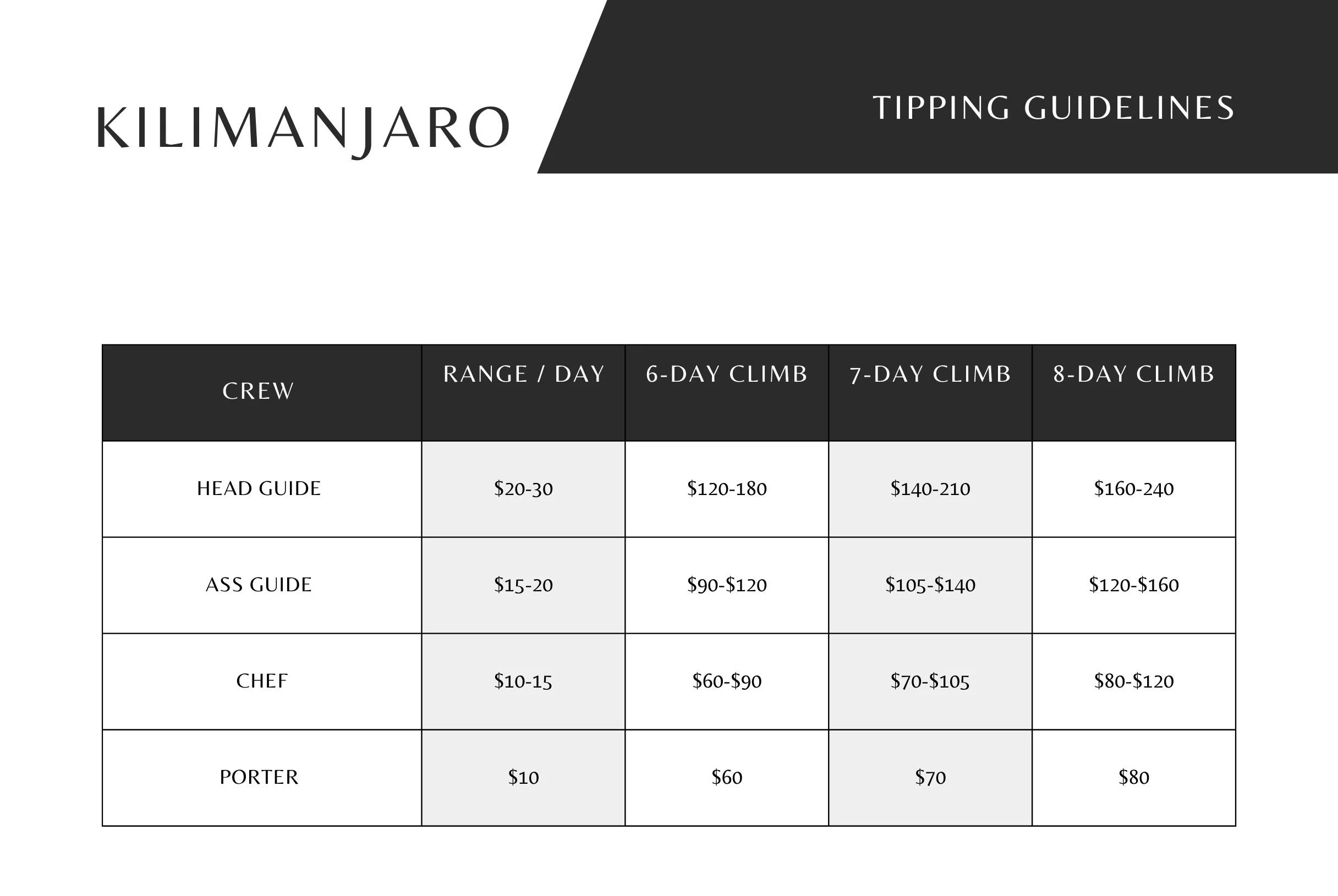
Generally, you should budget approximately 15% of your total climb cost for tips. If you are traveling in a small group, you will contribute more per person to the tip. Once we have firm numbers for your climb we will provide an indication of your crew size and their roles.
It is customary to give tips on the final morning of the climb. We recommend tipping each crew person directly. If you choose to give the full tip to the guide to distribute, please announce the total amount in front of the entire crew and the tip amount each crew member is to receive. The guide should repeat this in English and Swahili so that all can understand.
Please note that some porters have extra jobs such as toilet cleaner, camp crew, and waiter.
Porters may also volunteer to go to the summit to help carry bags and obtain valuable experience to become a guide later. Please tip these porters a bit more than porters who do not have extra jobs.
Tip amounts listed are per group, not per individual traveller
On the mountain
Daypack
You will not see your backpack from the moment you hand it to the porter in the morning until the end of the day. It’s therefore necessary to pack everything that you may need during the day in the daypack that you carry with you.
Go slowly
“Pole Pole” as they say in Swahili. This is very important during your first days of climbing. Even if you feel well, slow down and let your guide set the pace. The biggest cause of altitude sickness is ascending too high, too fast.
Drink enough water
Make sure that you drink at least 3 – 4 litres of liquid a day, preferably water. A functioning “body water balance” is one of the keys to a successful climb.
Eat Well
Fatigue is said to be a major contributor to AMS, so try to keep energy levels up by eating as much as you can.
Washing
At the end of the day’s walk you’ll turn up at camp to find your tent erected, with a bowl of hot water lying nearby for you to wash away the grime of the day.
Toilets
In between campsites there are no toilets so if you do really need to go make sure you’re at least 20m away from both the path and any streams or rivers. To help keep the mountain clean please carry a trowel which can be used to bury any waste and any toilet paper should be popped into a plastic bag and disposed of at camp.
Plastic Bag Ban
As of June 2019, Tanzania prohibits the use, manufacture or importation of thin polyethylene bags, with many countries across the globe are following suit.
“Plastic carrier items known as ‘Ziplock bags’ that are specifically used to carry toiletries will be permitted as they are expected to remain in the permanent possession of visitors and are not expected to be disposed in the country.”
Money + Currency
Be sure to notify your bank before you leave with your travel dates to East Africa or they may block your card. Also ensure any US Dollars (USD) you bring are from the year 2002 or later, most businesses will not accept notes earlier than 2002, and if by chance they do they will give a much lower exchange rate.
The Tanzanian Shilling is the official currency of Tanzania, its international currency code is TZS. Tanzania's tourist economy however operates primarily using the US Dollar, with most hotels and safari operators requiring payment in USD.
Tanzanian banknotes are issued in 500, 1,000, 2,000, 5,000 and 10,000 Shillings.
Coins are available in 1, 5, 10, 20, 50, 100 and 200 Shilling.
ATM's dispense TZS and the withdrawal limit is normally 400,000 TSH per day, lower in rural areas.
You can use your Visa/Mastercard/Eftpos and four digit PIN to withdraw TSH.
You cannot withdraw USD from ATM's.
You can use the Tanzanian Shillings for smaller expenses like shopping at local markets, restaurants, and supermarkets.
Paying for drinks or any extras that you might purchase in lodges by card will attract a 5% surcharge so consider carrying USD or TSH to make these payments.
See HERE for current Exchange Rates
At airports or in big cities like Dar es Salaam, Arusha and Moshi there are plenty of ATMs, but in smaller villages ATM’s are rare.
If you visit the northern part of Tanzania, you can also find ATM’s at the towns Karatu and Mto wa Mbu, enroute to the national parks.
In Zanzibar the ATMs are only at the airport and in Stone Town with Barclay’s usually being the most reliable. There are no ATMs at the beaches or the islands Pemba and Mafia so make sure you have enough USD for your whole trip before leaving Stone Town.
You should bring small bills and they need to be in good condition and as new as possible. Locals and stores will not take torn or notes in poor condition.
Be aware that some smaller vendors who accept USD will only dispense change in TSH i.e. bars and supermarkets etc
Electricity
Depending on where you are traveling from, you might need to bring a travel power plug adapter or, for some devices, a voltage converter.
If your appliance is compatible with a Type G plug, many lodges in Tanzania have these outlets. Type G features special slots for three flat pins and has been the modern British standard since 1947.
Tanzania is moving towards universal outlets, compatible with any type of plug, a basic dual universal outlet will accommodate any plug, negating the need for travel adapters.
It's unlikely you will come across a type D socket any more as they are mostly found in old buildings and are generally considered a rarity.
Electricity in Tanzania is between 220 - 240 Volts. This is the case in most of Europe, Australia, the United Kingdom and most countries in Africa and Asia. The standard frequency in Tanzania is 50Hz. If this voltage or frequency differs from the frequency used in your home country, please use caution when plugging in your devices. Most modern digital appliances are built to be compatible with all worldwide voltages, from 100 volts to 240, but you should always check.
Many camps and lodges do not have 24 hour electricity so we recommend charging your devices soon after arriving at your lodge or in your vehicle while on safari.
Your safari vehicle will offer power/charging ports.
There are no charging facilities on Mt Kilimanjaro.

Communication
You will need a local SIM or international data roaming active to access the internet on Kilimanjaro up to 3700m, reception can be slow or nonexistent on parts of the mountain.
Local network providers with reception include Vodacom, Airtel, Zantel, Tigo & Halotel.
Wi-Fi access is most commonly found along the Marangu Route. Climbers may be able to connect at Marangu Gate as well as at Mandara, Horombo, and Kibo huts, with some access also reported around Millennium Camp. That said, internet service in these areas is often inconsistent because of the mountain’s remote setting. Occasional power interruptions can further affect connectivity.
The Wi-Fi provided by the government is free to use, but users should expect slow speeds and unreliable performance, particularly during busy climbing periods.
Limited Wi-Fi may also be available at select camps on other routes, including Machame and Lemosho. However, both availability and connection quality depend heavily on the specific location and prevailing weather conditions, and service is not guaranteed.
In general, the connection is faster at the lower altitudes and slower at the higher altitudes. The connection can also be slower during peak climbing season when there are more users on the network.
We recommend you:
Disable data-intensive apps and keep your phone on airplane mode when you’re not using it
Enable low-power or battery-saving mode to extend battery life
Download essential apps, maps, music, and files before starting your climb.
If you absolutely need to stay connected to the outside world, it is best to bring a satellite phone or a satellite-enabled device.
Drones
Operating a drone in Tanzania requires special permits, a process that is complicated and costly. However, it is the only legal way to fly a drone in the country. Without the necessary permits, customs officials may confiscate your drone during baggage inspection, and park rangers have the authority to seize it within protected wildlife areas.
The TCAA also lists additional special considerations for foreigners including:
You must first obtain permission from the TCAA. The form to apply can be found HERE.
Only drones weighing 7 kilograms (15.5 pounds) or less may be flown in Tanzania.
As a foreigner you must also obtain permission from the Ministry of Defence and National Service.
You should contact the TCAA directly before you travel with any questions
tcaa@tcaa.go.tz / +255 22 211 5079
Photography
Consider a weather-sealed, durable camera to protect against rain, dust, and extreme temperatures. Look for models specifically designed to handle tough conditions.
Consider the camera’s weight and size. Carrying a lightweight, compact camera will make the journey more enjoyable.
Make sure you can comfortably carry your gear or arrange in advance a camera porter. We can arrange this in advance at approx $15 USD per day.
Make sure you bring enough memory cards, a blower brush and lens cleaning cloths
Cold weather can affect battery life, so bring multiple spare batteries and keep them warm in your inner pockets or sleeping bag.
There is nowhere to charge anything on the mountain itself
A tripod is essential for steady shots, particularly at sunrise and sunset
You are not allowed to film government buildings, military personnel, police, or large gatherings of people
As a sign of respect, always ask permission before photographing local people, as Tanzanians, like many cultures, generally prefer not to be photographed without consent. Some may also kindly request a small donation in exchange for their cooperation. Please approach photography with sensitivity to local customs and traditions.
Laundry
Laundry facilities are generally available at most lodges throughout Tanzania. Many lodges run off solar power and clothes will be dried in the sun. To avoid disappointment please check with the lodge on arrival regarding laundry and prepare to allow 24hrs for the return of laundry, weather dependent. We recommend taking a small bottle of travel detergent for underwear, it often comes in handy.
There are no laundry facilities on Kilimanjaro.
Safety
Tanzania is generally a safe, hassle-free country and Tanzanian people are very welcoming and happy.
Your safety and well-being is paramount to our team and the lodges you stay at.
That said, you do need to take the usual precautions and use common sense.
Keep valuables out of sight, particularly when walking in towns and cities, pickpockets are common throughout the country and loiter in busy areas such as markets and transport terminals.
Use the safes provided in your room; don't leave valuables lying around.
Keep the side windows up in vehicles when stopped in traffic in cities and towns (particularly Dar Es Salaam & Nairobi) and keep your bags out of sight (e.g. on the floor behind your legs).
Don't hang your phone/camera out the window of a vehicle in populated areas.
When shopping in local markets and stalls have a wallet with small amounts of local currency, avoid opening a wallet stuffed with USD and cards.
Don't get out of your vehicle in game parks unless your guide advises that it is safe to do so.